

By: Terri Walker
This is what Adonai says: “Do what is right and just; rescue the wronged from their oppressors; do nothing wrong or violent to the stranger, orphan or widow; don’t shed innocent blood in this place. Jer 22:3, CJB
God has always called His people to do what is just and right and to meet the needs of others. Yet, it’s so easy to become consumed with our own lives—our responsibilities, our concerns, and our needs. But how often do we intentionally look beyond ourselves and extend a helping hand or boldly advocate for someone else?
Genuine knowledge of God is demonstrated through action—by doing what is right and just, especially for the benefit of those in need. This is a direct reflection of God’s character (Psalm 89:14, NKJV). But doing what is right for others requires courage, because it can cost us our comfort, our resources, and sometimes even our reputation. You don’t have to be loud or have a dominant personality to stand for what is right, to do good, or to advocate for someone in need.
Sometimes, quiet strength is all that is needed. It doesn’t have to be paraded or spotlighted to matter. In fact, Scripture often shows the opposite—that some of the most powerful courageous acts are found in the simple decision to refuse to go along with what is wrong or humbly extend a helping hand.
Maybe you feel alone in a situation where you should take a stand, but don’t feel so courageous. Or you don’t think your support for someone could make a difference. It’s possible that doing right feels isolating if it risks something important to you. I want to highlight three powerful examples of those who exhibited quiet backbone. They did the right thing without fanfare and yet their stories are preserved in Scripture. Each one acted out of conviction and kindness—not for recognition—even when it could have cost them something.
Barzillai the Gileadite
Courage to provide support for a rejected king fleeing for his life.
Barzillai was one of few who cared for King David and his thousands of followers when they were fleeing from Absalom, David’s own son, who had led a revolt against him. You can imagine that this was a low time in David’s life and put him in a very vulnerable position. There was a conspiracy against him, uncertainty about whom he could trust, and the threat of death as he fled for his life.
Scripture states that David and his followers wept as they traveled:
“David continued up the road to the Mount of Olives, weeping as he went up, head covered and barefoot; and all the people with him had their heads covered and wept as they went up.” II Sam 15:30, CJB
During David’s crisis, Barzillai was courageous enough to express generosity and loyalty. He, along with Shobi and Machir, provided a bountiful supply of necessities for David and his followers as they traveled through the wilderness exhausted and distressed while remaining faithful to God.
27 Now it happened, when David had come to Mahanaim, that Shobi the son of Nahash from Rabbah of the people of Ammon, Machir the son of Ammiel from Lo Debar, and Barzillai the Gileadite from Rogelim, 28 brought beds and basins, earthen vessels and wheat, barley and flour, parched grain and beans, lentils and parched seeds, 29 honey and curds, sheep and cheese of the herd, for David and the people who were with him to eat. For they said, “The people are hungry and weary and thirsty in the wilderness.” II Samuel 17:27-29, NKJV
After God delivered David from his enemies and he began his journey back to Judah, Barzillai returned to escort the king across the Jordan. Deeply moved by his kindness, he asked Barzillai to cross over with him to Jerusalem and offered to take care of his needs. However, he humbly declined. He simply wanted to walk over with the king and then return home so he could die in his own city. Read II Samuel 19:31-39
Years later, as King David was near the end of his life, he gave instructions to his son Solomon. Among his final requests was a command to show kindness to Barzillai’s sons because of the generosity and loyalty that Barzillai had shown during David’s time of need. His righteous courage brought forth a generational blessing.
“But show kindness to the sons of Barzillai the Gileadite and let them be among those who eat at your table, for so they came to me when I fled from Absalom your brother. (I Kings 2:7, NKJV)
Eved-Melekh the Ethiopian
Courage to speak up and defend a prophet left to die.
During the reign of King Zedekiah, the prophet Jeremiah often spoke a word from God that many people paid no attention to. He was persecuted, imprisoned and then sentenced to be put to death for prophesying that those who surrendered to the Chaldeans would live, while those who remained in the city would die by the sword. This wasn’t a popular position, and he was accused of demoralizing the people. He was thrown into a muddy pit located in the king’s palace and left to die.
Ebed-Melech the Ethiopian, an officer of the king, heard what had been done to Jeremiah and knew that it was wrong. He didn’t wait for someone else to speak up. Courageously, he went directly to the king to speak up in defense of Jeremiah, calling out the evil act for what it was. Jeremiah likely would have died in that pit if Ebed-Melech had said nothing. And he didn’t stop at speaking up, he oversaw the rescue with detailed care—thoughtfully providing clothing and rags to prevent Jeremiah from injury while being pulled up with ropes.
6 So they took Jeremiah and cast him into the dungeon of Malchiah the king’s son, which was in the court of the prison, and they let Jeremiah down with ropes. And in the dungeon there was no water, but mire. So Jeremiah sank in the mire. 7 Now Ebed-Melech the Ethiopian, one of the eunuchs, who was in the king’s house, heard that they had put Jeremiah in the dungeon. When the king was sitting at the Gate of Benjamin, 8 Ebed-Melech went out of the king’s house and spoke to the king, saying: 9 “My lord the king, these men have done evil in all that they have done to Jeremiah the prophet, whom they have cast into the dungeon, and he is likely to die from hunger in the place where he is. For there is no more bread in the city.” 10 Then the king commanded Ebed-Melech the Ethiopian, saying, “Take from here thirty men with you, and lift Jeremiah the prophet out of the dungeon before he dies.” Jeremiah 38:6-10, NKJV
Years later, through Jeremiah, God promised Ebed-Melech that his life would be spared when He passed judgment on the city. His courageous act was remembered by God and counted as faith.
15 Meanwhile the word of the Lord had come to Jeremiah while he was shut up in the court of the prison, saying, 16 “Go and speak to Ebed-Melech the Ethiopian, saying, ‘Thus says the Lord of hosts, the God of Israel: “Behold, I will bring My words upon this city for adversity and not for good, and they shall be performed in that day before you. 17 But I will deliver you in that day,” says the Lord, “and you shall not be given into the hand of the men of whom you are afraid. 18 For I will surely deliver you, and you shall not fall by the sword; but your life shall be as a prize to you, because you have put your trust in Me,” says the Lord.’” Jer 39:15-18, NKJV
Shiphrah and Puah the Midwives
Courage to refuse an evil command in order to preserve innocent lives.
Over 200 years after the death of Joseph, the Israelites had multiplied abundantly and were growing powerful in the land of Egypt. Fearing their increasing strength, the Egyptians began to oppress them with forced labor and made their lives miserable. The king of Egypt commanded the Hebrew midwives to kill all males at birth as an attempt to control the population.
15 Then the king of Egypt spoke to the Hebrew midwives, of whom the name of one was Shiphrah and the name of the other Puah; 16 and he said, “When you do the duties of a midwife for the Hebrew women, and see them on the birthstools, if it is a son, then you shall kill him; but if it is a daughter, then she shall live.” 17 But the midwives feared God, and did not do as the king of Egypt commanded them, but saved the male children alive. Exodus 1:15-17, NKJV
However, the midwives refused to obey the instructions of their oppressor. This defiance could have cost them their lives, but they feared God more than man. Righteous courage is not only seen in what we choose to do, but also in what we refuse to take part in.
Their obedience to God did not go unnoticed. Scripture says that God blessed them both with families of their own because of their reverence for Him. Their bold courage also allowed the nation of Israel to continue to grow in number and strength.
20 So God was good to the midwives, and the people [of Israel] multiplied and became very strong. 21 And because the midwives feared God [with profound reverence], He established families and households for them. Ex 1:20-21, AMP
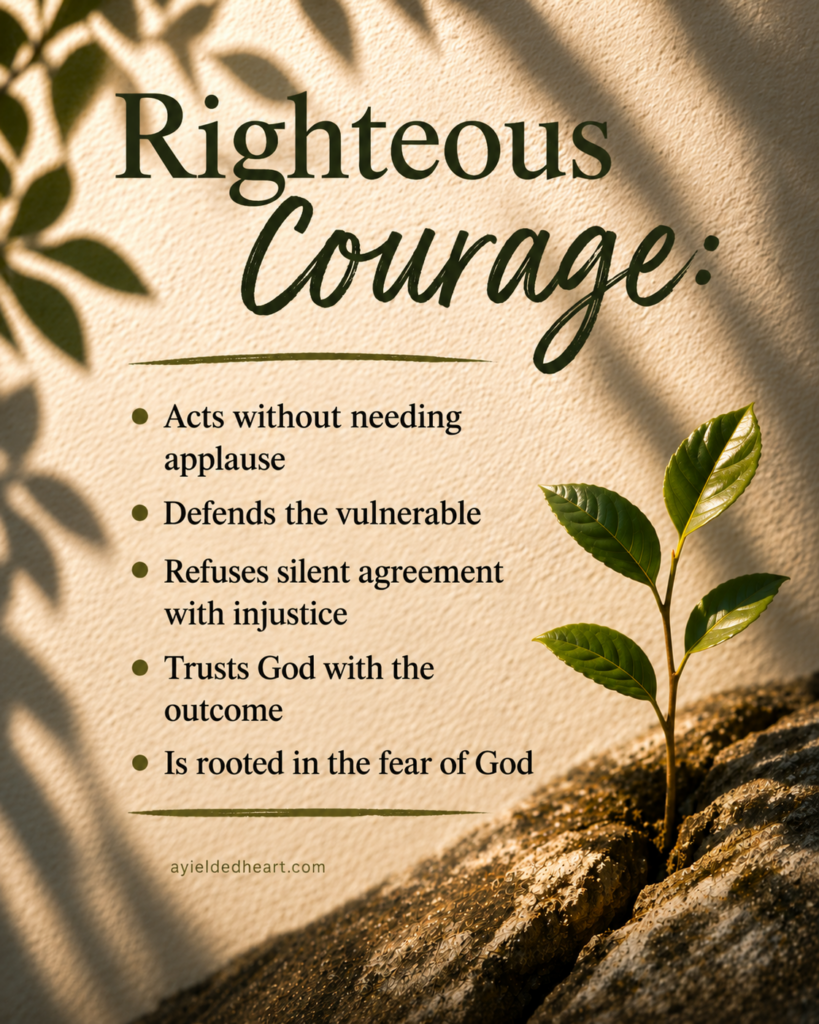
“Righteous courage often appears in simple acts…”
There’s a beautiful thread woven through the stories of Barzillai, Ebed-Melech, and Puah and Shiphrah. None of them were center stage or sought the spotlight, nevertheless their courage was bold.
Their stories are a reminder to us that righteous courage often appears in simple acts—helping someone who is being mistreated, speaking up against evil, or giving what we have to support someone in need. Scripture shows that God sees these acts of justice. And though blessings may follow, the true mark of righteous courage is that it acts because it is right and reflects God’s character, not because it is rewarded. This is the kind of courage that reshapes families and generations.
Pay attention to what’s going on around you. Self-care has its place, but not at the expense of serving and supporting others in times of need. Act on what you know is right and just…isn’t that what knowing God is all about?
Scriptures for Further Reflection
8 Speak up for those who can’t speak for themselves, or the rights of all who need an advocate. 9 Speak up, judge righteously, defend the cause of the poor and the needy. Pro 31:8-9, CJB
Reflection: Have I remained silent in a situation where I knew in my spirit something was wrong and I needed to speak up?
3 …regard each other as better than yourselves — 4 look out for each other’s interests and not just for your own. Phil 2:3-4, CJB
Reflection: Am I willing to inconvenience myself to serve someone else or am I mostly concerned with my own needs?
To do righteousness and justice is more acceptable to the Lord than sacrifice. Pro 21:3, NKJV
Reflection: Do I treat righteousness and justice as important to God, or am I only focused on outward acts of worship?
Most people announce that they show kindness, but who can find someone faithful [enough to do it]? Pro 20:6, CJB
Reflection: Would the people who know me best say that I live out compassion—or that I mostly talk about it?
Read More Lessons
Righteous Courage: Standing Up for Others
This is what Adonai says: “Do what is right and just; rescue the wronged from their oppressors; do nothing wrong or violent…
Read more

“You Give Them Something to Eat”: Living in Christ’s Authority Today
15 When it was evening, His disciples came to Him, saying, “This is a deserted place, and the hour is already…
Read more

Rediscovering Reverence: Setting Our Hearts to Treasure God Above All Else
‘Gather the people to me, and I will make them hear my very words, so that they will learn to…
Read more
See All Lessons
Printable Lessons
Study scripture without the distraction of screens by downloading a free printable version of every lesson.
See Printable Lessons